The TACO seminar
The TACO seminar focuses on topics in Topology, Algebra, Combinatorics, and Operators.
| Date | Speaker | Title |
|---|---|---|
| Sep 2 | Noah Snyder Indiana University Bloomington |
Interpolation Categories for Conformal Embeddings [abstract] |
| Abstract |
We give a diagrammatic description of the categories of modules coming from the conformal inclusions \( (sl(N),N) \; < \; (so(N^2-1),1) \). A small variant on this construction has uniform generators and relations which are rational functions in \( q = e^{2\pi i/4N} \), which allows us to construct a new continuous family of tensor categories at non-integer level which interpolate between these categories. This is the second example of such an interpolation category for families of conformal inclusions after Zhengwei Liu's interpolation categories \( (sl(N), N + 2) \; < \; (sl(N(N+1)/2),1) \) which he constructed using his classification Yang-Baxter planar algebras. Our approach is different from Liu's, we build a two-color skein theory, with one strand coming from \( X \) the image of defining representation of \( \mathfrak{sl}_N \) and the other strand coming from an invertible object \( g \) in the category of local modules, and trivalent vertex coming from a map \( X \otimes X^* \to g \). This is joint work with Cain Edie-Michell. |
|
| Sep 9 | Aaron Lauve and Tony Giaquinto Loyola University Chicago |
Fence Posets, Good Gradings and Frobenius Maximal Parabolics [abstract] |
| Abstract |
For Frobenius maximal parabolic subalgebras of sl(n), we prove that the multiplicities of the eigenvalues of the algebra's principal element form a unimodal and symmetric sequence about 1/2, and that the related spectrum on the full matrix algebra is symmetric and unimodal about zero. The proof uses Panyushev reduction, fence posets, good gradings, and Frobenius duality. This is joint work with John Irving and Mitja Mastnak of Saint Mary's University. |
|
| Sep 16 | Aaron Lauve and Tony Giaquinto Loyola University Chicago |
Fence Posets, Good Gradings and Frobenius Maximal Parabolics (Part II) [abstract] |
| Abstract |
For Frobenius maximal parabolic subalgebras of sl(n), we prove that the multiplicities of the eigenvalues of the algebra's principal element form a unimodal and symmetric sequence about 1/2, and that the related spectrum on the full matrix algebra is symmetric and unimodal about zero. The proof uses Panyushev reduction, fence posets, good gradings, and Frobenius duality. This is joint work with John Irving and Mitja Mastnak of Saint Mary's University. |
|
| Sep 24 | Hugh Thomas (THURSDAY at 4 PM in IES 110) UQAM |
Distributivity of lattices via linear algebra [abstract] |
| Abstract |
A partially ordered set is a set equipped with an order. A good example to have in mind is the collection of all subsets of a set, ordered by inclusion. A partially ordered set is called a lattice if for every pair of elements there is a unique smallest element greater than both, called their join, and a unique greatest element less than both, called their meet. (In the case of the poset of subsets of a set, the join is the union and the meet is the intersection.) A lattice is called distributive if the operations of meet and join satisfy a distributive law (just like the distributive law that is familiar from arithmetic). I will present recent work with Viktória Klász and René Marczinzik (arXiv:2501.09447) in which we give a characterization of whether or not a lattice is distributive in terms of linear algebra. A well-studied permutation of the elements of a distributive lattice, known as rowmotion, will also turn out to make a natural appearance from this point of view.. |
|
| Sep 30 | Analysis seminar: Alexey Cheskidov (4-5 pm in IES110) | See analysis seminar info. [abstract] |
| Abstract |
See analysis seminar info: https://fermat.math.luc.edu/analysis_seminar/ . |
|
| Oct 7 | Rafael González D'León Loyola University Chicago |
A Möbius function computing h-polynomials of nestohedra [abstract] |
| Abstract |
We introduce a poset of weighted hypergraphs on a fixed vertex set which has a remarkable property: the Möbius values of the intervals associated to any hypergraph give, up to sign, the coefficients of the h-polynomial of its nestohedron. We exploit this relation to provide two new recurrence relations to compute h-polynomials of nestohedra. This is joint work with Nicolas Avila and Sergio Carrillo. |
|
| Oct 14 | No talk | No talk [abstract] |
| Abstract |
Abstract TBD. |
|
| Oct 21 | Emily Peters Loyola University Chicago |
The loop braid group and loop Hecke algebra. [abstract] |
| Abstract |
If braids are thought of as motions of a set of points in the plane, then we might try to create a higher-dimensional analog of braids by looking at motions of a set of points in 3d space. However, in this context we lose the non-commutativity that makes braids interesting: in (3+1)-d, point A going behind point B is the same as point A going in front of point B. We can get non-commutativity back though, by introducing tiny loops instead of points: for loops, it's still true that passing in front and passing behind are equivalent, but now we have the additional motion of passing one loop through the other! |
|
| Oct 28 | Jaime Herrera Loyola University Chicago |
A normal form for the Thin Flat Surface category [abstract] |
| Abstract |
Abstract TBD. |
|
| Nov 11 | Stephen London Loyola University Chicago |
Paterson's worms [abstract] |
| Abstract |
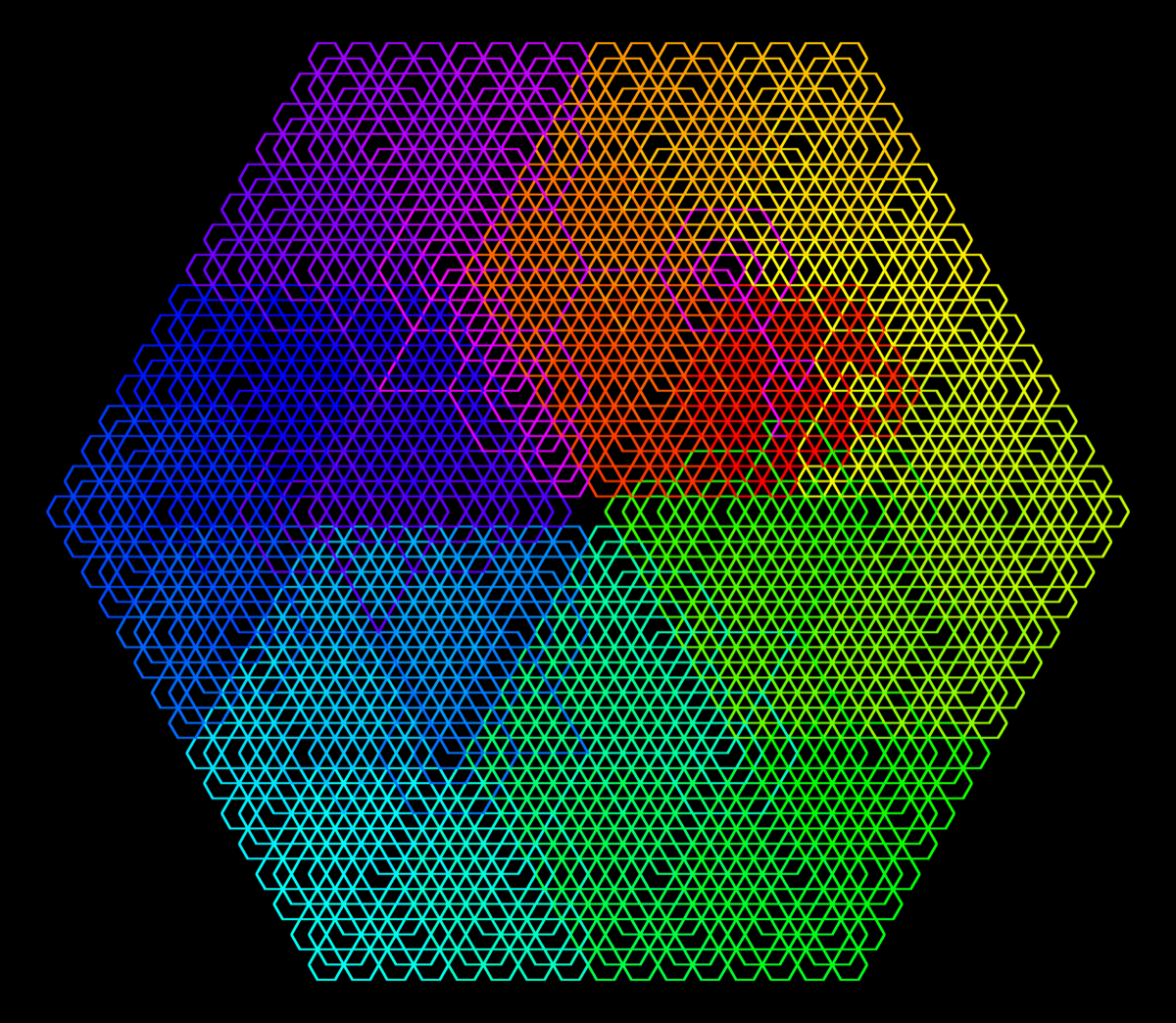
We will explore Paterson’s worms. Developed by Mike Paterson and John Horton Conway in 1971 and made popular by Martin Gardner’s Scientific American column later that year, these worms eat their way through a triangular isometric grid and their paths can form complex and beautiful patterns with a very simple set of rules. We will use a computer to explore and discuss the current status of what is known and unknown.
The talk is accessible to anybody including undergraduates. |
|
| Nov 18 | Russ Woodroofe University of Primorska FAMNIT |
Partitionability is NP-complete [abstract] |
| Abstract |
A simplicial complex is said to be partitionable if its set of faces may be partitioned into parts, each consisting of all the faces between a facet \sigma and some face \varphi(\sigma) \subseteq \sigma. Every shellable simplicial complex is also partitionable, and a partitioning scheme exposes the number of faces (the h-vector) in a convenient manner. In this talk, I will explain why deciding whether a simplicial complex is partitionable is NP-complete (even for 2-dimensional complexes). This answers a 1995 question of Kleinschmidt and Onn. It was the last main question remaining open in this subarea: NP-completeness of determining shellability was settled by Goaoc, Paták, Patáková, Tancer, and Wagner, and deciding the Cohen-Macaulay property is polynomial in fixed dimension. The proof was AI- and computer-assisted. |
|
| Nov 25 | Thanksgiving break | No talk [abstract] |
| Abstract |
A lot of pie will be consumed. |
|